
Led by the booming e-commerce sector, private equity investments in India surged over 17 per cent with deals worth $ 11.49 billion

Investments by private equity and venture capital funds (PE/VC) declined by 22 per cent in March to $4.6 billion spread across 107 deals, a report said on Wednesday. The deal activity showed an increase of 54 per cent by value at $15.5 billion across 360 deals, largely on the back of heightened activity in the startup space, the monthly report by IVCA and EY said. "While India's position as an attractive destination for PE/VC investments is expected to remain strong in 2022 given its high growth and macroeconomic and policy stability, the continuing geopolitical tensions, rising inflation, quantitative tightening by the US FED and inversion in the US yield curve are potential downside risks, making investors circumspect," Partner at EY Vivek Soni said.
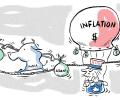
'The biggest risk to the Indian markets from a 12-18-month view is that the current government does not get re-elected, or loses in a way that is not represented at all in the next central government.'

Good pay hikes, positive macroeconomic factors and the taming of inflation have had a positive effect on purchases

Tax collection at source would lock in Rs 400 crore of seller money, say Flipkart, Amazon, Snapdeal.

Job openings for permanent staffers at fresher level will be adversely affected due to the overall hiring freeze amid the second wave of COVID-19, while temporary or gig workers seem to be better placed, says a survey. According to a survey by staffing and HR services company Genius Consultants, over 57 per cent respondents believe that new job positions for permanent employees will suffer a major impact of the overall hiring freeze. However, just 43 per cent of respondents believe the same for temporary or gig workers, it noted.

Maharashtra's "radical" lockdown move will have an economic impact of Rs 40,000 crore, with the trade, hotels and transport sector to bear the biggest dent, Care Ratings said on Monday. The rating agency said the loss of economic activity will have a 0.32 per cent impact on the gross value added (GVA) growth at the national level. It revised down its national GDP growth estimate to 10.7 - 10.9 per cent from the 11 - 11.2 per cent given a week ago. Maharashtra has been contributing nearly 60 per cent to the daily COVID-19 infections nationally and had over 57,000 new cases on Sunday.

Black Friday sales in India received a good response as brands dropped their prices making customers queue up outside stores where discounts were steeper. Discounts were offered both online and offline. Most of the international brands in India offered discounts under the Black Friday Sale banner. The Black Friday Sale started in the US on the Friday after Thanksgiving Thursday. The day typically marks the beginning of the Christmas shopping season ahead of the festival.

With expectations of customers changing and demand for seamless, uninterrupted shopping increasing, tech companies are now using this fear of becoming irrelevant as a sales pitch to sell their products to traditional retailers.

'In the current scenario e-commerce delivery is flourishing, driving demand.'

The central government's clarification on the 2 per cent equalisation levy on foreign digital operators in the Budget, which considerably expands the scope of the levy, might be challenged in court, with several companies contemplating filing a writ petition in the coming few weeks. The writs might be filed on the grounds of the levy's alleged extra-territorial overreach, as it aims to cover those entities that do not have a physical presence in India, going against international taxation rules.

The new jobs - created both directly and indirectly - will be across industries, including IT, skill development, content creation, retail, logistics, and manufacturing.

Online retail in India touched $12.6 billion in 2013.

Did top Indian business groups miss the e-commerce opportunity by focusing on replicating the Walmart model instead of following the Amazon model of online shopping?

Currently Jack Ma owns 7.6 per cent of Alibaba and Joe Tsai owns 3.1 per cent.

While the first half of the year saw India's e-commerce market shrinking, the success of Diwali sales will boost the sector beyond last year's benchmark

Online marketplace majors, e-grocers, Internet of Things firms, app-based companies and transport service aggregators are among those that have had to shut shop or scale down operations. Now, survival skills like upskilling and retraining will determine who makes it.

Billionaire Mukesh Ambani's Reliance Industries on Friday reported a 43 per cent jump in its September quarter net profit as its businesses from oil to retail fired on all cylinders, growing both sequentially and on a year-on-year basis. Net profit of Rs 13,680 crore, or Rs 20.88 per share, in July-September compared with Rs 9,567 crore, or Rs 14.84 a share, in the same period a year back, the company said in a statement. While better realisation and a sharp rise in crude oil prices benefited the old-economy business, retail saw footfalls at stores reach pre-Covid levels and per user earning from telecom business rose.

The founder of the e-commerce firm, which specialises in procurement of industrial products, believes if he plays his cards right, his company could become a unicorn with a valuation of $1 billion in 5 years.

What we want from spectrum allocation is access to broadband networks at prices that will result in productivity gains.


Internet, tech, infra, realty in India might gain

Walmart is rumoured to be looking to listing Flipkart in a few years. At that stage, we'll get a better sense of what's going on in retail, says Devangshu Datta.

Reliance Industries on Friday reported a 41.5 per cent jump in its third quarter net profit as oil, retail and telecom businesses fired on all cylinders. Net profit of Rs 18,549 crore in October-December compared with Rs 13,101 crore a year back, the company said in a stock exchange filing. Income from operations rose to Rs 1.91 lakh crore from Rs 1.28 lakh crore.

Radhakishan S Damani, investor and promoter of the D-Mart supermarket chain, has broken into the elite club of the top 100 global billionaires. Damani, who grew up in a single-room apartment in Mumbai, is now ranked 98th on the Bloomberg Billionaires Index with $19.2 billion as his net worth. The index is a daily ranking of the world's richest people. The other Indians on the top 100 rich list ahead of Damani are Mukesh Ambani, Gautam Adani, Azim Premji, Shiv Nadar, and Lakshmi Mittal.

Companies have also managed to find talent created by frequent exits.

'At Snapdeal, our aim is to become the best-in-class technology company.'

Surge in UPI transactions is because of an increased consumer interest in making bill payments and recharging mobile phones online, and purchase of non-essential goods on e-commerce platforms.

The Dubai-based Lifestyle International runs a retail chain.
There seems to be no dearth of funds to fuel this growth, report Peerzada Abrar and Shivani Shinde.

In 2015, Infosys, under the leadership of then CEO Vishal Sikka, had bought Israeli automation technology firm Panaya for around $ 200 million and e-commerce service provider Skava for $1 20 million. The buyouts were mired in controversy owing to allegation of over-payment apart from not being an ideal fit.

Immunity boosting foods and drinks. Sustainable fashion. Beauty products with natural ingredients. There was always a market for these, and the pandemic has only made it bigger. Within beauty, brands have recorded a greater demand for ayurveda products.

With 16 start-ups gaining unicorn status in 2021, India's tally has touched the 50 mark. The newest entrant to this list include Pune-based MindTickle, which is close to finalising a $100-million funding round from Softbank's Vision Fund 2, taking the company's valuation to $1.1 billion.

The reopening of schools and colleges has sparked a crisis in the edtech sector with falling valuations, slowing funding rounds and faltering investor sentiment. In a totally altered, post-pandemic landscape where students are back at school and colleges, companies are scrambling to revert to bricks-and-mortar tuition centres and adopting a hybrid model of offline and online education. Demand for online tuition has fallen, affecting the revenue of edtech companies in recent months. After two years of booming revenues, some experts say the sector is looking at a possible meltdown.

Estimates by retail consultancy Technopak suggest that direct subsidy to consumers because of e-commerce this year would be over Rs 12,000 crore.

Billionaire Mukesh Ambani-run Reliance Industries Ltd's retail arm on Thursday raised Rs 9,555 crore from Public Investment Fund (PIF) of Saudi Arabia, taking total fundraise in the last two months to Rs 47,265 crore. PIF will take a 2.04 per cent stake in Reliance Retail Ventures Ltd (RRVL), the Indian firm said in a statement. The investment values RRVL, the retail arm of Reliance Industries Ltd, at a pre-money equity value of Rs 4.587 lakh crore.

The company is likely to choose one of its existing auditing partners -- PricewaterhouseCoopers, EY (formerly Ernst & Young) and KPMG -- as an advisor for the listing process.

The facility, which will manufacture nicotine and nicotine salts, will conform to stringent US and EU pharmacopoeia standards that define purity levels at 99.2 per cent for nicotine meant for pharmaceutical products. ITC will leverage the institutional capabilities of its century-old leaf tobacco business for this. ITC's cigarettes business saw disruptions across the value chain with the onset of the Covid-19 pandemic. The company mentioned in its annual report that with easing of restrictions and improvement in mobility from September 2020 onwards, the business recovered progressively over the remainder of the year to reach nearly pre-Covid levels towards the close of the year.

What seems to have changed over the last two-three years is that earlier the CCI considered online as another channel for retail sales, while it now seems dividing the retail market into two -- online and offline, and looking at them separately, say competition law experts.

Housing prices may rise 5 per cent next year on improved demand, according to Knight Frank India. In its '2022 Outlook Report', the property consultant said: "While 2021 was mostly impacted by the volatility due to the pandemic, 2022 may prove to be a more stable year for the sector both for commercial as well as the residential sector." On the housing segment, the report said that sales momentum is expected to continue in 2022 as prospective homebuyers' preferences for bigger homes, better amenities, and attractive pricing will keep them interested to seal the deals.
